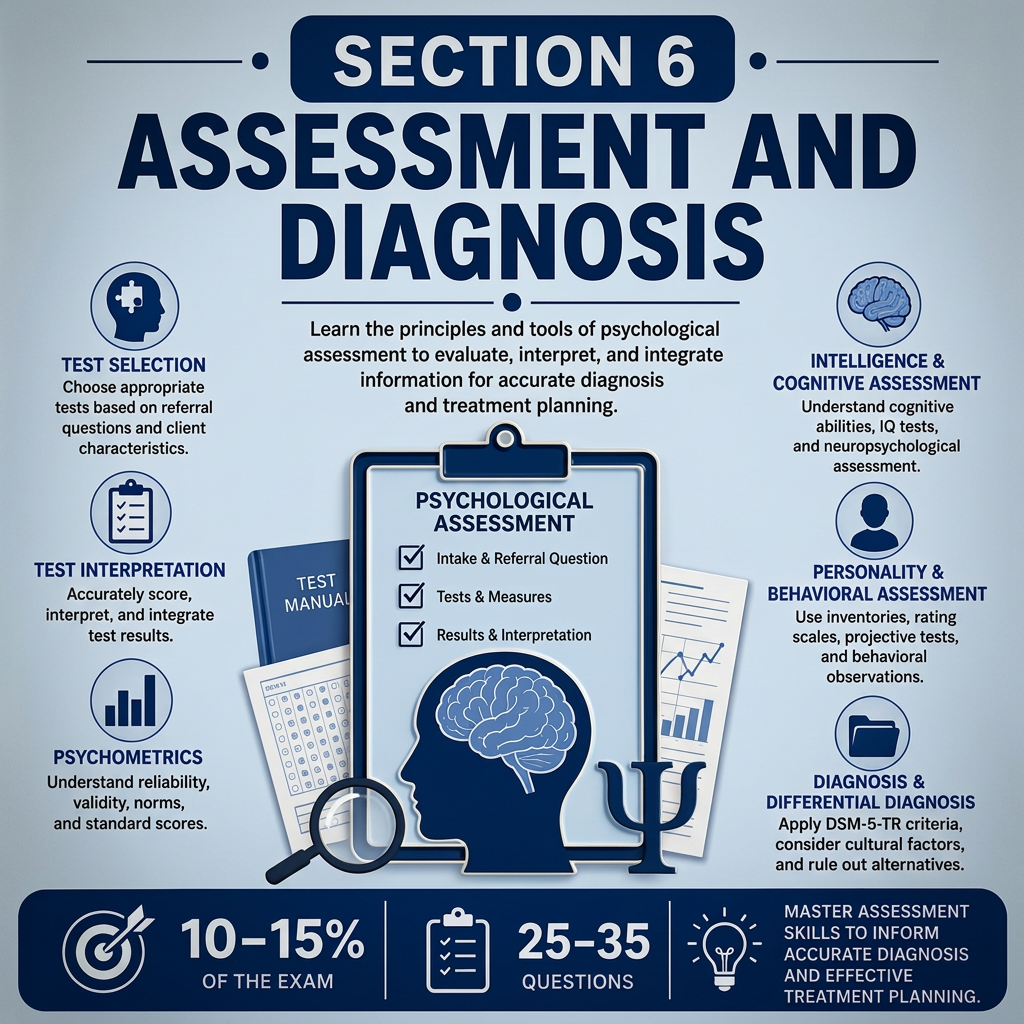
Section 6: Assessment and Diagnosis provides a comprehensive review of the principles and tools used to evaluate psychological functioning and make informed diagnostic decisions. This section prepares you to understand how psychologists select, administer, score, interpret, and integrate assessment information in clinical practice.
You will review essential topics including test selection and interpretation, psychometrics, reliability and validity, norms and standard scores, intelligence and cognitive assessment, personality and behavioral assessment, and diagnosis and differential diagnosis. Special attention is given to applying DSM-5-TR criteria, considering cultural and contextual factors, and distinguishing between disorders with similar presentations.
The goal is to help you move beyond memorization and develop the ability to apply assessment concepts to EPPP-style clinical scenarios, select appropriate assessment methods, interpret findings accurately, and use assessment data to support sound diagnosis and effective treatment planning.
Section 6: Assessment and Diagnosis provides a comprehensive review of the principles and tools used to evaluate psychological functioning and make informed diagnostic decisions. This section prepares you to understand how psychologists select, administer, score, interpret, and integrate assessment information in clinical practice.
You will review essential topics including test selection and interpretation, psychometrics, reliability and validity, norms and standard scores, intelligence and cognitive assessment, personality and behavioral assessment, and diagnosis and differential diagnosis. Special attention is given to applying DSM-5-TR criteria, considering cultural and contextual factors, and distinguishing between disorders with similar presentations.
The goal is to help you move beyond memorization and develop the ability to apply assessment concepts to EPPP-style clinical scenarios, select appropriate assessment methods, interpret findings accurately, and use assessment data to support sound diagnosis and effective treatment planning.